Best Free AI Voice Cloning Tools 2026 (Compared & Ranked)
The 3 Best Free AI Voice Cloning Tools for Podcasters (Tested and Ranked)
Voice cloning technology has reached a point where you can create a convincing copy of your voice (or any voice with permission) and use it to generate audio content. For podcasters, this means editing mistakes without re-recording, creating consistent narration, or even producing content in languages you don’t speak.
I cloned my own voice with ElevenLabs to hear how it holds up, and lined all three tools up on genuine free access, cloning limits, and licensing.
Key Takeaways
- ElevenLabs offers the best quality but limits free users to preset voices only
- Chatterbox is the easiest genuinely free option: MIT-licensed, clones from about 5 seconds of audio, and runs on an official Hugging Face demo with no signup
- OpenVoice V2 is the free pick for other languages: MIT-licensed, six native languages, and it can read text in a language your sample never used
- Resemble AI and Uberduck left this list because neither currently offers free voice cloning
- Best overall for podcasters: Chatterbox (free) or ElevenLabs (paid for quality)
Quick Comparison Table
| Tool | Free Voice Cloning | Quality | Free Limit | Best For |
|---|---|---|---|---|
| ElevenLabs | ❌ Preset voices only | ⭐⭐⭐⭐⭐ | 10,000 chars/mo | Professional quality |
| Chatterbox | ✅ Yes (open source) | ⭐⭐⭐⭐ | No cap on the public demo | Free cloning, commercial use allowed |
| OpenVoice V2 | ✅ Yes (open source) | ⭐⭐⭐ | Free (MIT license) | Free cloning in 6 languages |
Clone Your Voice with ElevenLabs
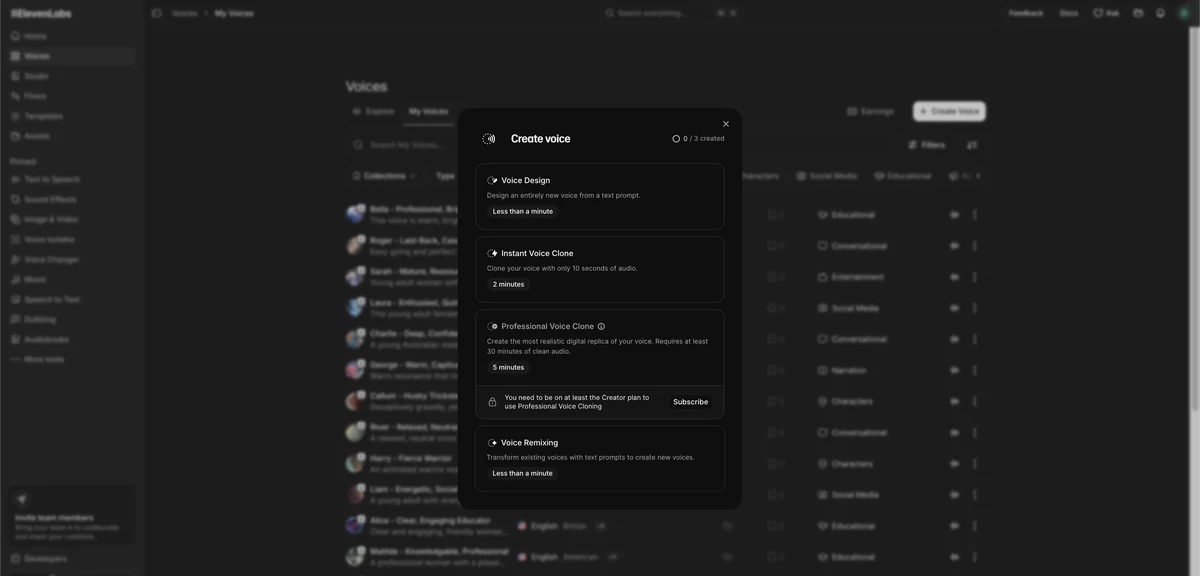
Instant Voice Cloning on the $6/month Starter plan, with a commercial license included. The free tier lets you test the preset voices first.
Try ElevenLabs Free →1. ElevenLabs - Best Quality, Limited Free Tier
ElevenLabs is widely considered the gold standard for AI voice synthesis. The quality is remarkably natural, with proper emotional inflection and realistic speech patterns.
ElevenLabs Free Tier
- ✅ 10,000 characters per month
- ✅ Access to 29+ preset voices
- ❌ No voice cloning on free tier
- ❌ Commercial use not allowed
Voice Cloning (Paid)
To clone your voice on ElevenLabs, you need the Starter plan ($6/month) which includes:
- Instant Voice Cloning from as little as 10 seconds of audio (1 to 2 minutes gives a steadier clone)
- Professional Voice Cloning with more samples (Creator plan)
- Commercial license for generated audio
Quality Assessment
Naturalness: 10/10 - Virtually indistinguishable from human speech Emotion: 9/10 - Handles scripts with appropriate emotional range Consistency: 9/10 - Maintains voice character across long scripts
Verdict: ElevenLabs produces the best quality, but free users can’t clone their own voice. For podcasters willing to pay, it’s the top choice.
2. Chatterbox - Best Free Voice Cloning
Chatterbox is an open-source voice cloning model from Resemble AI, released under the MIT license. That makes it free for personal, research, and commercial projects rather than a trial that expires. It clones a voice zero-shot from a short clip, and the official Hugging Face demo runs in the browser with no account or install. The step-by-step walkthrough is in my free voice cloning guide.
Chatterbox Free Access
- ✅ Free under the MIT license, commercial use included
- ✅ About 5 seconds of audio is enough
- ✅ Official Hugging Face demo, no signup
- ✅ Self-host on your own hardware for volume work
- ⚠️ The public demo is built for testing, not batch production
- ⚠️ English-first; OpenVoice V2 (below) covers Spanish, French, Chinese, Japanese and Korean
Voice Cloning Process
- Open the ResembleAI/chatterbox-turbo-demo Space on Hugging Face
- Upload or record about 5 seconds of clean speech
- Type your text, add emotion tags if you want them, generate, and download the file
There is no training step, so the clone is ready as soon as the audio renders.

Quality Assessment
A short zero-shot sample gives a recognizable, usable clone: good enough for personal projects, quick tests, and content where perfection is not required. It will not match a professionally trained model built from hours of audio, and stability is lower than a trained clone. In Resemble AI’s own published blind test, 63.75% of listeners preferred Chatterbox over ElevenLabs; my ElevenLabs vs Chatterbox comparison looks at that claim in detail.
Verdict: Chatterbox is the pick for podcasters who want cloning without paying. MIT license, commercial use allowed, five seconds of audio. Move to ElevenLabs when you need a trained clone and a polished workflow.
Clone Your Voice Free in Five Minutes
The guide walks through Chatterbox and OpenVoice V2 on their official Hugging Face demos, no signup needed.
Open the Free Cloning Guide →For the best Chatterbox result, upload about 5 seconds of clean speech with no background noise or music. A short clean clip beats a long noisy one.
3. OpenVoice V2 - Free Cloning in Six Languages
OpenVoice V2 is an open-source voice cloning model from MyShell and MIT researchers, released under the MIT license since April 2024, so commercial use is allowed. Like Chatterbox, it clones zero-shot from a short clip, and its official Hugging Face demo runs in the browser with no signup.
OpenVoice V2 Free Access
- ✅ Free under the MIT license, commercial use included
- ✅ One short, clean clip is enough
- ✅ Official Hugging Face demo, no signup
- ✅ Natively supports English, Spanish, French, Chinese, Japanese and Korean
- ⚠️ Best results stay within those six languages
- ⚠️ The public demo is built for testing, not batch production
Cross-Lingual Cloning
OpenVoice V2 can clone a voice from an English sample and read Japanese or Spanish text back in that voice, without re-recording in the new language. That makes it the free option for podcasters who publish in more than one language.

Quality Assessment
A short zero-shot sample gives a recognizable clone, much like Chatterbox: fine for short clips and personal projects, with small tone and pacing imperfections that a trained clone avoids.
Verdict: OpenVoice V2 is the free pick when you need your voice in Spanish, French, Chinese, Japanese or Korean. For English-only work, Chatterbox is simpler.
Detailed Comparison
For a hands-on route that costs nothing, the free voice cloning guide walks through cloning with Chatterbox and OpenVoice before you commit to a paid tier.
Cloning Comparison
| Aspect | ElevenLabs | Chatterbox | OpenVoice V2 |
|---|---|---|---|
| Audio needed | 10 seconds to 2 minutes (Instant) | About 5 seconds | One short clip |
| Commercial use | Paid plans | Yes (MIT license) | Yes (MIT license) |
| Where it runs | ElevenLabs web app | Hugging Face demo or self-hosted | Hugging Face demo or self-hosted |
| Cost to clone | From $6/month (Starter) | Free | Free |
Pricing Comparison
| Tool | Free Tier | Starter Plan | Pro Plan |
|---|---|---|---|
| ElevenLabs | 10K chars | $6/mo (30K chars) | $22/mo (100K) |
| Chatterbox | Free (MIT license) | None (open source) | None (self-host for volume) |
| OpenVoice V2 | Free (MIT license) | None (open source) | None (self-host for volume) |
Voice Cloning for Podcasters
Pros
- Edit mistakes without re-recording the entire segment
- Maintain consistent voice across episodes even when sick
- Create content in multiple languages using your voice
- Generate promotional content efficiently
- Produce supplementary content without studio time
Cons
- Ethical concerns about voice impersonation
- Quality may not match actual recordings for main content
- Requires consent for cloning anyone's voice
- Free tiers have significant limitations
- May sound synthetic for emotional content
Ethical Considerations
Voice cloning raises important ethical questions:
- Only clone voices with consent - Never clone someone’s voice without their explicit permission
- Disclose AI usage - Be transparent with your audience about AI-generated content
- Avoid impersonation - Don’t use cloned voices to deceive or mislead
- Platform policies - Check each platform’s terms regarding synthetic voices
- Copyright and likeness rights - Respect intellectual property laws
Most platforms require verification that you own or have permission to clone a voice.
Best Tool for Each Use Case
| Use Case | Recommended Tool | Why |
|---|---|---|
| Professional podcasts | ElevenLabs (paid) | Best quality and naturalness |
| Free voice cloning | Chatterbox | MIT license, commercial use, about 5 seconds of audio |
| Free cloning in other languages | OpenVoice V2 | MIT license, six native languages, cross-lingual |
| Multiple languages | ElevenLabs | 29 languages from one clone |
Start Voice Cloning Today
Chatterbox is free and MIT-licensed. When you want a trained clone and a commercial license, ElevenLabs Starter is $6/month.
Try ElevenLabs Free →Final Recommendations
For podcasters on a budget: Start with Chatterbox. It is free, MIT-licensed for commercial use, and clones from about five seconds of audio on the official Hugging Face demo. Quality is good enough for personal projects and short clips where perfection is not required.
For professional quality: Invest in ElevenLabs. The $6/month Starter plan is worth it if audio quality matters for your brand. It’s the closest to indistinguishable from human speech.
For more than one language on a zero budget: Use OpenVoice V2. It is MIT-licensed and can read Spanish, French, Chinese, Japanese or Korean text in a voice cloned from an English sample.
FAQ
Is AI voice cloning legal?
Yes, cloning your own voice is legal. Cloning others' voices requires their explicit consent. Using cloned voices for fraud, impersonation, or to spread misinformation can be illegal. Always obtain permission and disclose AI usage.
How much audio do I need to clone my voice?
It ranges from about 5 seconds to several hours. Zero-shot tools like Chatterbox work from roughly 5 seconds of clean audio, ElevenLabs' Instant Voice Cloning recommends 1 to 2 minutes, and professional-grade cloning needs 30 minutes to 3 hours. Clean audio without background noise matters more than length.
Can I use cloned voices for commercial podcasts?
It depends on the platform and plan. Chatterbox and OpenVoice V2 are MIT-licensed, so commercial use is allowed at no cost. ElevenLabs' free tier doesn't allow commercial use; paid plans do. Always check the specific terms for commercial licensing.
How accurate are AI voice clones?
Modern clones can be remarkably accurate. ElevenLabs is nearly indistinguishable in quality. Chatterbox and OpenVoice V2 produce recognizable, usable clones that may be detectable on close listening. Quality depends on source audio and platform.
Can I clone voices in other languages?
Yes, most platforms support multiple languages. ElevenLabs supports 29 languages from one clone. Chatterbox is English-first, while the separate open-source model OpenVoice V2 natively supports English, Spanish, French, Chinese, Japanese, and Korean. You can create content in languages you don't speak using your cloned voice - the AI handles pronunciation.
What's the best free voice cloning option?
Chatterbox is the best genuinely free option for English. It is MIT-licensed, clones from about 5 seconds of audio, and runs on an official Hugging Face demo with no signup. For Spanish, French, Chinese, Japanese or Korean, OpenVoice V2 is the free alternative. ElevenLabs' free tier has no cloning.
What happened to Resemble AI and Uberduck on this list?
Both dropped off in September 2026. Resemble AI's pricing now covers deepfake detection and security plans with no self-serve voice cloning, and Uberduck's plans list voice access, raps and image cloning but no voice cloning. Chatterbox, which Resemble AI still publishes as an open-source model, stays on the list.
Note: Play.ht and LOVO AI, both previously featured in this comparison, have shut down, and Resemble AI and Uberduck no longer offer free voice cloning. Chatterbox and OpenVoice V2 now cover the free options.